
Mobility in Sport: Beyond Flexibility and Into Function (Part 1: Defining & Assessing “Mobility”)
- Nov 7, 2025
- 7 min read
Updated: Dec 15, 2025
Mobility has become something of a buzzword in the fitness world in recent times, often used in varying contexts and interpreted in various ways. To start off and keep things clear and consistent throughout this blog, I’ll define mobility as the active ability to access joint positions. In contrast, I’ll refer to flexibility as the passive ability to access joint positions, typically with the aid of external forces. A simple example: try lifting one finger off a table using only your own muscles (mobility), then compare that to how far you can pull it up using your other hand (flexibility).

I vividly remember a conversation with a brilliant physio I met in Cape Town back in 2019. We were discussing my ankle function and range of motion (ROM) deficits, using the classic knee-to-wall test as a tool to evaluate my dorsiflexion range. At the time, I was struggling with ankle issues and, in my true inquisitive fashion, immediately asked, “Well, how many inches should my foot be from the wall to pass the test?”
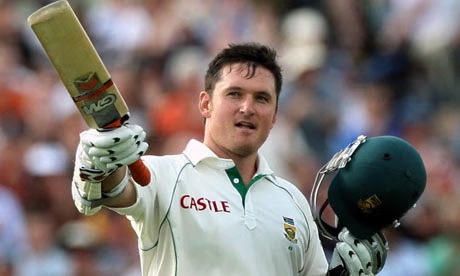
What followed was far more illuminating than a simple benchmark. The physio shared an example involving former South African opening batsman Graeme Smith (which instantly got me interested!), who had battled recurring plantar fasciitis. Over time, they observed a clear pattern: whenever the distance between his toes and the wall decreased from 4 cm to 3 cm on the knee-to-wall test, his painful symptoms would return. That 1cm shift was a tipping point—highlighting how even small changes in ROM could influence pain, function and performance.
It sparked something in me. When we tested my own dorsiflexion, I had nearly double the range Graeme had. I remember asking, half-jokingly, “Do I have too much range?” That question stayed with me. What is the “right” amount of mobility? Does mobility actually matter? Is more always better? Or, like Graeme, do our bodies operate best within an individualised window? In my opinion, this last question is getting closer to the point. However, all these questions are missing one vital component that must be considered: force. An appreciation of what positions an individual needs efficient and fluid access to, as well as understanding whether they need to be able to express high levels of force within sporting time constraints in these positions, is paramount for not only high performance but also for the durability of the joint as a whole.
This experience marked the beginning of a broader exploration into mobility prerequisites—not as universal and normative standards, but as context-dependent qualities shaped by sport, position, history, and task demands. Within this four-part blog I will attempt to unpack some of these questions along with exploring the key physiological concepts around mobility, how our ability to access certain positions and ranges may impact our expression of force, mobility and its interdependent relationship with stability, the concept of ‘runways’ and discussing practical implications of how one can actually go about improving their mobility and ability to access certain positions.
Assessing Mobility – The Beighton score, FMS & the Future
Firstly, how does one know whether they are mobile or not? What constitutes “good” mobility? To help answer these questions in the 1960s, Peter Beighton developed the commonly used ‘Beighton score’ as a way in which to determine whether an individual was either hypermobile or hypomobile. “Hypermobile” refers to the ability of joints to move beyond what is deemed a physiologically “normal” ROM. On the other hand, hypomobile refers to the ability of joints to move less than what is deemed a physiological “normal” ROM. A score is calculated by accumulating points for passing specific tests, like achieving 90° of passive dorsiflexion in the pinky finger or being able to touch the palm of your hands to the floor with fully extended legs. A total of 9 points can be attained, with a score over 5 placing an individual on the hypermobile side of the scale.

Although such clinical tests can allude us to perhaps some more generalised findings in terms of an individual's level of mobility, I think we can clearly see a few major flaws. Firstly, the overall “genericness” and lack of specificity due to the Beighton score only assessing 5 parts of the body (pinky finger, thumbs, elbows, knees & spine/hamstrings) I believe to be problematic. More simply put, how does the ability of your pinky finger to bend backwards to 90° mean that your shoulder has the prerequisite external rotation range for throwing a cricket ball or serving in tennis? I think, rather obviously, it does not! Furthermore, the test leans towards a fair amount of subjectivity when it comes to the scoring system. Advancements in technology and goniometer apps now allow for more accurate, objective data to be collected, underpinning our decisions as coaches. Finally, the most crucial flaw of the Beighton score test is that the test only assesses passive ranges of motion. As I previously defined at the beginning of this blog, the ability for a joint to access a position with the use of an external force refers to flexibility, not mobility. In sport we require the ability to actively get into specific joint positions and shapes based on the constraints of the task. Passive flexibility has little carryover and serves no real purpose for functional performance within sport or even daily life.
Moving on through my explorative journey of mobility assessment tools, I discovered Max El Hag Training Think Tank’s and James Fitzgerald’s OPEX education platforms, which very quickly led me towards Gray Cook’s Functional Movement Screen (2010). Now, I certainly do not think this would be a blog post about mobility without discussing FMS! Gray Cook developed FMS, aiming to assess mobility restrictions leading to poor movement patterns which could increase chances of injury. At the time, I saw the FMS as a step closer to an optimal tool for evaluating mobility, as it addressed the limitations of Peter Beighton’s test by assessing an individual’s ability to actively achieve specific joint positions through 7 movement patterns. Unfortunately, FMS too comes with its own flaws similar to the Beighton score. While the FMS is certainly more comprehensive, it still falls short in the specificity needed to assess functional mobility for specific sporting tasks, and once again, it relies heavily on a subjective scoring system. Therefore, due to these flaws, can such a tool really predict injury risk? I would argue not, despite Dennis and colleagues’ (2008) and Kiesel and colleagues’ (2007) papers, which both concluded good reliability for the use of the functional movement screen within cricket and football. More recent work by Bishop and colleagues (2015) and Moran and colleagues (2017) both concluded that there is no correlation between FMS scores and the ability to predict injury with the use of movement assessments. The quest continues to find the most optimal tool for assessing mobility. Does such a tool even exist? I hope you are quickly realising general tools for assessing mobility will never be specific enough for the demands of specific task demands.



Referring back to my initial point, we must consider an “appreciation of what positions an individual needs efficient and fluid access to” regarding the activities and sport they partake in. In my opinion, it is a necessity to consider the joint actions and biomechanical implications that underpin any sporting action. The paper Test-Training Integration to Optimize Performance and Health in Baseball Pitchers: An Outcome Driven Approach by Morrison and colleagues (2024) does exactly this. The authors have drawn some rough lines in the sand indicating what ranges and in which joints are necessary to maintain a healthy, high-performing baseball pitcher. For example, during the windup phase of the throw, it is suggested at least 64° of trunk (thoracic) rotation range is required. Additionally, during the late cocking and deceleration phases of the throw, 103° of shoulder external rotation and subsequently 42.4° of shoulder internal rotation range are suggested.
Now although this need for specificity in our assessment of mobility or range of motion is moving in the right direction as shown, we must take into consideration these suggested values are just a rough guide. As Stu McMillan once said, “We’re all unique snowflakes, all moving in different ways, and it’s up to us to explore all our uniqueness,” highlighting the importance of understanding the individual placed in front of us. We can never be 100% certain specific values will keep us healthy and performing to our potential. So to answer – how does one know whether they are mobile or not? And what constitutes “good” mobility? I think it is fair to say that any answer is embedded within the constraints and demands of the task and the individual's wants and needs to perform in their chosen sport or task. In my opinion, “good mobility” does not exist, and a better question would be, “Can I access the positions and shapes required for the task I want to do?” If not, you have work to do.
References / Sources:
Beighton, P. H., & Horan, F. (1969). Orthopaedic aspects of the Ehlers. Danlos syndrome. The Journal of Bone & Joint Surgery British Volume, 51(3), 444-453.
Bishop, C., Read, P., Walker, S., & Turner, A. (2015). Assessing movement using a variety of screening tests. Professional strength and conditioning.
Cook, G. (2011). Movement: Functional Movement Systems. Screening—Assessment—Corrective Strategies. Lotus Publishing.
Dennis, R. J., Finch, C. F., Elliott, B. C., & Farhart, P. J. (2008). The reliability of musculoskeletal screening tests used in cricket. Physical Therapy in Sport, 9(1), 25-33.
Kiesel, K., Plisky, P. J., & Voight, M. L. (2007). Can serious injury in professional football be predicted by a preseason functional movement screen?. North American journal of sports physical therapy: NAJSPT, 2(3), 147.
Moran, R. W., Schneiders, A. G., Mason, J., & Sullivan, S. J. (2017). Do Functional Movement Screen (FMS) composite scores predict subsequent injury? A systematic review with meta-analysis. British journal of sports medicine, 51(23), 1661-1669.
Morrison, G., Ashworth, B., & Read, P. J. (2024). Test-Training Integration to Optimize Performance and Health in Baseball Pitchers: An Outcome Driven Approach. Strength & Conditioning Journal, 46(6), 646-658.
OPEX - James Fitzgerald
Stuart McMillan - ALTIS Founder
TJ Malherbe - Cape Town Physiotherapist
Training Think Tank - Max El Hag